A First-Time Animation Festival Visit, Planned Around Looking
Plan a first-time animation festival visit around a few films, useful visual questions and breathing space, so you can watch attentively without rushing.
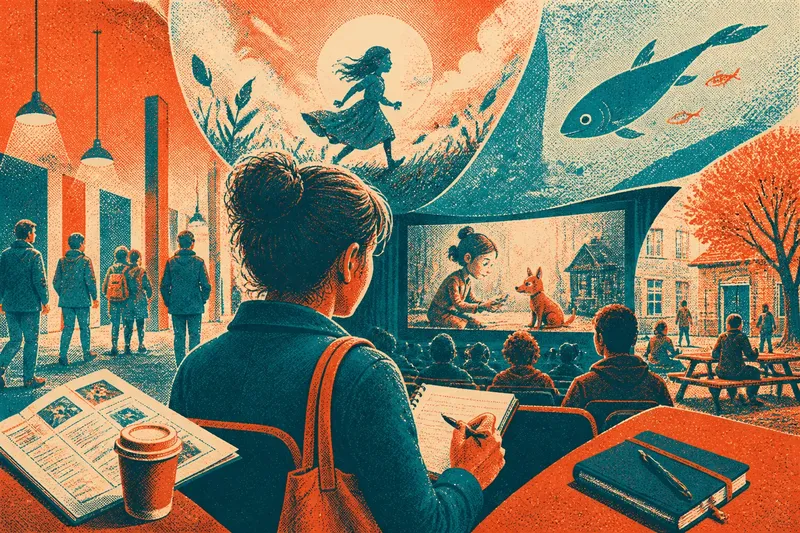
You have the festival programme open on your phone, three screenings overlap, and every description sounds tempting. A first-time animation festival visit can feel less like a treat than a test of whether you have chosen correctly. It need not: plan around a small handful of films and leave room to notice what each one does.
Too many choices
Festival programmes invite comparison. One film promises painted landscapes, another stop-motion creatures, and a third is described in a sentence that makes no sense until you see it. Trying to fit in everything can turn the day into a race between rooms, with little attention left for the films themselves.
Choose a small set of screenings before you arrive. Start with one film that makes you curious, then consider a second that offers a clear contrast in material or storytelling. A short programme can be a good anchor: its varied films offer several visual approaches without requiring you to commit the whole day to one feature.
Check the practical details in the programme: screening length, venue, access information and whether a session includes an introduction or discussion. Leave a comfortable gap between appointments, especially if rooms are in different buildings. You do not need a theme that links every choice; curiosity is enough.
Say you are drawn to a hand-painted short and a feature made with miniature sets. Put those in separate sessions, with time between them to get a drink and jot down one question. The expected result is not a perfect comparison, but enough breathing space to remember what caught your eye.
Screenings feel rushed
A tight schedule can make you watch the clock instead of the screen. Travel across a venue, a queue for the loo or a slow exit may take longer than the programme suggests, and arriving flustered can make it harder to settle into a film.
Build the day around fewer screenings than you think you can manage. If two films are close together, check whether the next room is nearby and whether the first session is likely to include a talk. When the gap is too short to move comfortably, choose one; missing a film is kinder than spending both screenings anxious about the transition.
Also decide in advance what you are willing to skip. A ticket or a packed schedule does not obligate you to stay through a session that is not working for you. Leave quietly between films if you need a reset, and use the interval for water, food or a few minutes outdoors rather than scrolling through every programme note.
What is not worth the effort is plotting a minute-by-minute itinerary, complete with exact café stops. A simple note with screening times, room names and one flexible break is easier to use when the day changes.
Notes interrupt looking
Some visitors try to record every technique, image and plot turn, then discover they spent much of the screening writing. Others leave with a vivid feeling but cannot recall what produced it. Both problems come from asking a notebook to do too much while the film is still moving.
Keep notes between screenings, not during scenes that have your attention. Write a few words about a visual question rather than a verdict: “Why does the background stay still here?” or “When does the texture change?” A question keeps you alert without turning viewing into an exam.
Use a small notebook or the notes app on your phone, whichever is less distracting. Make a separate line for each film: a striking image, a change in movement or colour, and something you are unsure about. If you cannot remember a detail, leave it blank instead of filling the gap with a guess.
A useful prompt is to ask what changed and when. Did a character’s movement become sharper as the scene grew tense? Did the palette narrow before a transition? You do not need to name a technique correctly; describing the visible change gives you something concrete to revisit later.
Visual questions that help
Looking closely does not require specialist vocabulary. Pick one question before a screening and let it guide your attention lightly; if the film takes you somewhere else, follow it. These prompts work especially well when a programme includes different forms of animation:
- What moves? Notice whether the characters, background, camera, light or several elements seem to carry the motion.
- What stays still? A stable shape or repeated setting can make a changing gesture easier to notice.
- What changes the mood? Watch for shifts in colour, spacing, texture, pace or the amount of detail on screen.
- What does the film leave out? A gap between actions, a sound without a visible source or an unexplained cut may invite you to complete the scene.
These are invitations, not boxes to tick. One film may make a question feel useful; another may resist it altogether. That difference is part of what you can notice, and there is no need to force a neat answer.
When a film feels opaque
An unfamiliar visual style or a fragmentary story can leave you wondering whether you have missed something. Sometimes a programme note adds context, but reading every note beforehand can also narrow your expectations and make you hunt for a single intended meaning.
Give the film a little time before deciding it is incomprehensible. Track something observable: a shape that returns, a change in how a character moves, or the relation between a sound and an image. You may not be able to explain the plot, yet still recognise a pattern or emotional shift.
If a film remains puzzling, write down the point where your attention changed. Was there a new setting, a jump in time or a sudden shift in materials? That small detail is more useful for reflection than a general note saying “didn’t get it”. You can compare impressions with a companion afterwards, while keeping space for different readings.
Between screenings?
Should I read the programme notes first?
Read the practical details before you go, then choose how much context you want about each film. A short description can help you recognise a subject or format, while leaving the images themselves to surprise you.
What if I do not understand a film?
Notice a recurring image, movement or sound, and let that be enough for a first viewing. Confusion is not proof that you watched badly; some films leave connections unresolved on purpose.
Is it better to go alone or with someone?
Either can work. Going alone makes it easy to follow your own pace, while a companion can offer a different observation afterwards; agree that neither of you has to explain the film for the other.
How many screenings should I choose?
Choose fewer than your maximum possible number if you want time to think and move between venues calmly. Your comfort, the schedule and the length of the sessions matter more than collecting a particular number of films.
Leaving room to reflect
The last screening often ends with a room emptying around you and the next event already calling. Before leaving the venue, find a quiet seat or an uncrowded patch of corridor and give yourself a few minutes. Write down the image you can still see in your mind, then note one question that has not gone away.
Keep the reflection modest. You might compare how two films used texture, or remember that a small gesture stayed with you longer than an elaborate sequence. Avoid ranking every film while the experience is fresh; a first impression can be valuable without becoming a final judgement.
If you attended with someone, trade one observation each rather than trying to settle what a film “meant”. If you went alone, a brief voice note on the journey home can serve the same purpose. Leave room for an impression to change after sleep, a conversation or another viewing.
A first-time animation festival visit works best when your plan protects attention rather than filling every gap. Pick a few films, carry one or two visual questions from room to room, and let the last minutes belong to your own response. The most useful note may be the one that points you towards what you want to notice next time.