The Continuity Myth: Why Matching Every Detail Can Flatten a Scene
Animation continuity keeps a scene readable while selective changes in light, props and layout give a character’s actions clearer meaning and emotional weight.
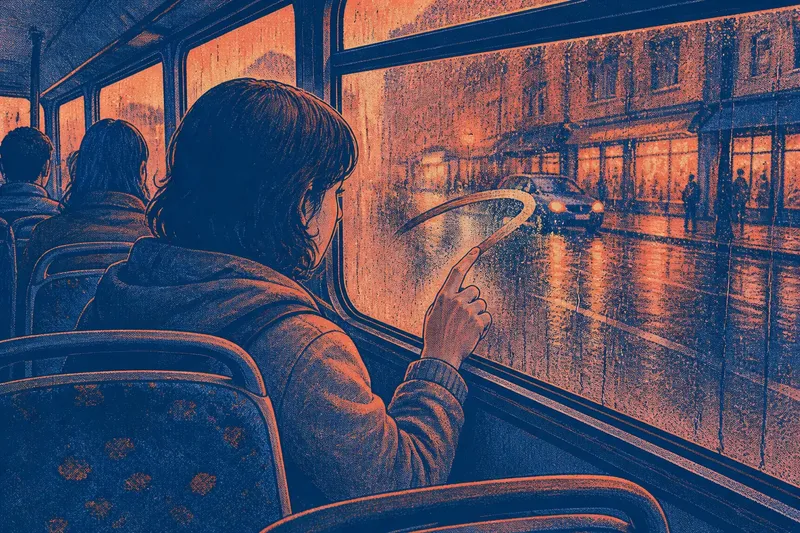
On a rainy bus, a passenger presses a fogged window with one finger, leaving a clear trail through the mist. Animation continuity lets that new mark matter: the glass, seat and passenger stay recognisable while the trail changes what the image tells us.
Animation continuity anchors
Continuity is not the same as identical drawings. It is the set of visual relationships that lets a viewer recognise a place and follow what happens there: the passenger sits by the window, the bus moves in a particular direction, and the finger leaves a mark where it touched the glass.
Choose a few anchors before refining a scene. These might be the direction of travel, the layout of the seats, the shape of a distinctive prop, or a patch of light that identifies the time and place. A change to an anchor can still work, but it needs a visible cause or a clear storytelling purpose.
Changes that carry meaning
Variation becomes expressive when it alters the viewer’s understanding, not merely the surface of the image. A door left ajar can turn a familiar hallway into a place of uncertainty; a cup moved away from someone can suggest a withdrawal that dialogue might leave unstated.
Imagine a passenger on a rainy bus who initially watches the city through a clear window. The animator begins with a crisp reflection of shopfronts, then lets raindrops break that reflection as the passenger lowers their gaze. The bus layout stays recognisable, while the changing glass links the passenger’s attention to the passing street.
Keep changes legible by giving them room. If the reflection, the passenger’s clothing and the seat pattern all alter at once, the viewer may not know which shift matters. It is not worth painstakingly matching every tiny raindrop when the important relation is clear: the passenger looks away, and the reflected street loses its hold on the image.
Cause and consequence
A change feels connected when the scene supplies a cause. A curtain lifts because a window is open; a chair turns because someone has just left it; a smear appears where a hand dragged across a surface. These details make a setting respond to events instead of behaving like a collection of independent decorations.
Say a character enters a quiet archive and sets a damp umbrella beside a stack of catalogues. First, keep the desk and catalogue labels in place. Then show water gathering on the umbrella tip and darkening one patch of floor beneath it; the expected result is a small but readable trace of the character’s arrival, without moving the surrounding shelves or changing the room’s layout.
Which details should change?
Can a background change during a shot?
Yes, if the shift belongs to the scene, such as clouds altering the light or a train window carrying the landscape past. Keep the change distinct from accidental flicker by tying it to an event the viewer can follow.
When should a prop stay recognisable?
Keep its defining shape and colour clear when the audience needs to identify it or understand how a character uses it. Distortion can support a stylised action, but the object should return to a readable form before its identity becomes important again.
What should a continuity review check?
Look for changes that alter the viewer’s sense of place, action or cause. If a shift is hard to explain, either make its cause visible or simplify it until the intended story detail stands out.
Continuity review decisions
Review the scene in passes, making a decision for each observation rather than trying to perfect every detail at once. The list below uses a fictional bus scene in which a passenger turns from the window towards the aisle; each item asks what to check and what to do with either result.
- Check the passenger’s screen direction: if the turn still leads towards the aisle, keep the pose; if it reverses towards the window by mistake, adjust the body angle.
- Check the seat and window relationship: if they remain in their established places, leave the layout; if either jumps, restore its position or make a deliberate viewpoint change clear.
- Check the window reflection: if it fades as the passenger looks away, keep the change; if it flickers without a cause, simplify the reflection or connect it to passing scenery.
- Check the passenger’s hand: if it leaves a clear trace on the glass, preserve the mark; if the mark appears elsewhere, align it with the hand or remove it.
- Check the rain pattern: if its movement supports the bus journey, retain the broad flow; if individual drops distract from the turn, reduce their activity.
- Check the seat fabric: if its pattern stays quiet behind the face, keep it; if a shift draws the eye from the passenger, settle the pattern or reduce its contrast.
Why does consistency matter?
Does continuity require still backgrounds?
No. Background motion can establish weather, travel or a change in attention, provided it does not obscure the action the viewer needs to follow. The useful question is whether that movement contributes to the scene’s meaning.
Can a deliberate mismatch help a scene?
Yes. A room that subtly changes after a character receives troubling news can make their unease visible, especially if the shift is composed as an emotional effect rather than an unexplained production slip.
How can a small detail carry a story?
Let it change in response to an action and give the viewer time to notice the difference. A wet footprint leading away from a doorway, for instance, can imply someone has entered without requiring a new shot of their arrival.
Let details respond
Animation continuity works best when it preserves the relationships needed to read a scene and lets other details respond to what is happening. A setting can feel active without every object moving: a reflection fades, a surface bears a fresh mark, or a prop shifts because a character has handled it.
When refining animation continuity, ask what changed, what caused it and what the viewer should understand as a result. That simple chain keeps a scene coherent while giving its details a reason to be there.