The Held Frame: How Pause Length and Placement Shape Animated Motion
See how pause length and placement shape animated motion, making a lift feel effortful, a glance tense or a still moment calm and easy to read.
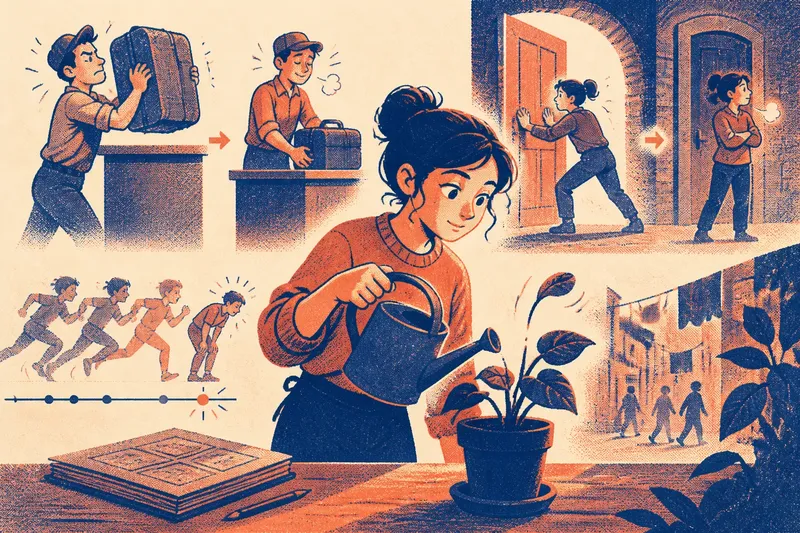
A porter raises a suitcase towards a counter, stops with bent elbows, then heaves it up. That held frame makes the lift feel effortful; move the pause until after the case is safely down and it may read as relief instead. In animation, pause length and placement shape how we interpret motion.
Effort at the stop
A pause can make effort visible by letting a strained pose register. Bent knees, raised shoulders and a tight grip suggest that the character is still working, even though the body has stopped moving.
Imagine a porter lifting a packed case. The starting point is the case halfway to the counter and the porter’s elbows tucked in. If the porter holds that pose, then continues the lift, the expected reading is resistance; if the pause comes after the case lands and the shoulders drop, the moment is more likely to read as recovery.
Length and expectation
A brief pause can feel like a breath within an action. A longer one gives the viewer more time to ask why the movement has stopped, which can suggest hesitation, listening or anticipation rather than weight.
Duration does not carry a fixed meaning on its own. A hand held above a doorknob may seem hesitant, while the same hand held still after turning it may suggest that the character is listening. The action and pose give the interval its context.
Placement shapes suspense
A pause before an action makes it feel imminent or deliberate. A pause afterwards lets the result register. Between two movements, it can split one smooth gesture into separate intentions: reach, stop, then grasp.
Consider a heavy door. A character who pauses while bracing just before pushing it seems to anticipate resistance; a pause after the door swings shut gives the impact and reaction distinct moments. The same stillness can therefore change how we read the action by shifting where it falls.
Motion around stillness
A character’s pose stands out when something else keeps moving. A sleeve settling or hair swinging onward can make the body’s stop easier to notice, while motion across the background can make the whole scene feel as if it continues around the character.
If everything stops together, the scene may feel suspended or dreamlike rather than physically heavy. It is not worth treating every flicker in the background as a clue; start with the main action and follow other motion only when it changes your reading.
Rhythm gives context
A sudden stop after a quick approach feels sharper than one after a slow drift. A held pose followed by a quick release can suggest restraint, while a gentle continuation may make the same pause feel calm.
Repeated timing also shapes expectation. If a character pauses before pushing several objects, a later pause can make us anticipate resistance. Break that pattern, and an ordinary movement may feel unexpected because the earlier rhythm taught us what to expect.
Reading animation pauses?
Does a longer hold always make an object feel heavier?
No. A longer hold may make effort easier to notice, but it can also signal hesitation, attention or waiting. The pose and the action around it help distinguish those readings.
Why can a pause feel tense?
A pause leaves an action unresolved, giving the viewer time to anticipate what comes next. A fixed gaze or a body braced to move can sharpen that expectation.
Does stillness mean the character has stopped exerting effort?
Not necessarily. A strained pose can show continued effort without visible movement, while a relaxed stance or a release of tension suggests rest or recovery.
Where should I look during a pause?
Start with the body’s balance and the object it is handling, then notice the eyes and any movement nearby. Together, those details can suggest bracing, waiting, listening or recovering.
A pause-reading checklist
- Observe whether the body looks strained; if shoulders are raised or knees bent, read the hold as possible effort, then compare it with the action that follows. If the pose is relaxed, consider rest instead.
- Check whether the pause happens before, during or after the main action; if it comes before, expect anticipation or choice, then look for the action it prepares. If it comes after, focus on the result and reaction.
- Notice whether the character’s gaze stays on a target; if it does, read the hold as possible focus or anticipation, then watch whether the character acts on that attention. If the gaze shifts to another person, consider communication or caution instead.
- Look for motion in hair, clothing or the background; if something continues moving, compare it with the still body to see whether the pause feels more pronounced. If everything stops, consider a suspended or dreamlike effect instead.
- Compare the speed just before and after the hold; if the approach is quick or the release sudden, read the pause as a sharper interruption. If both movements are gentle, consider a calmer rhythm instead.
- Check whether the same pause pattern has appeared earlier; if it has, use that pattern to predict what the character may be preparing to do. If the pattern changes, watch for a new intention rather than assuming the old one still applies.
For a fully worked reading, imagine an invented scene with a character holding a watering can above a houseplant. The starting pose has one hand gripping the handle and the eyes fixed on the soil. First, note that the hold occurs before the pour, so it prepares an action; next, notice that the grip is firm but the shoulders are relaxed, which points away from heavy strain; then see that the eyes stay on the plant while a leaf continues to sway, making the character’s stillness stand out. The likely reading is careful aim rather than a weighty lift. If the character’s shoulders were raised and the can visibly pulled the arm down, the balance would shift towards effort.
What the frame leaves
To read an animated pause, track what moved just before it, what the pose suggests now and what the scene leads you to expect next. Pause length matters, but its placement and surrounding motion give it meaning.
When a gesture feels unusually forceful, watch the instant before it finishes. That held moment may be where the scene lets effort become visible, or where it quietly redirects your attention to what comes next.