Before the Cel: A Short History of Drawing Animation on Paper
Drawing animation on paper reveals how artists planned movement, revised poses and prepared scenes for the camera, from early sequences to cel production.
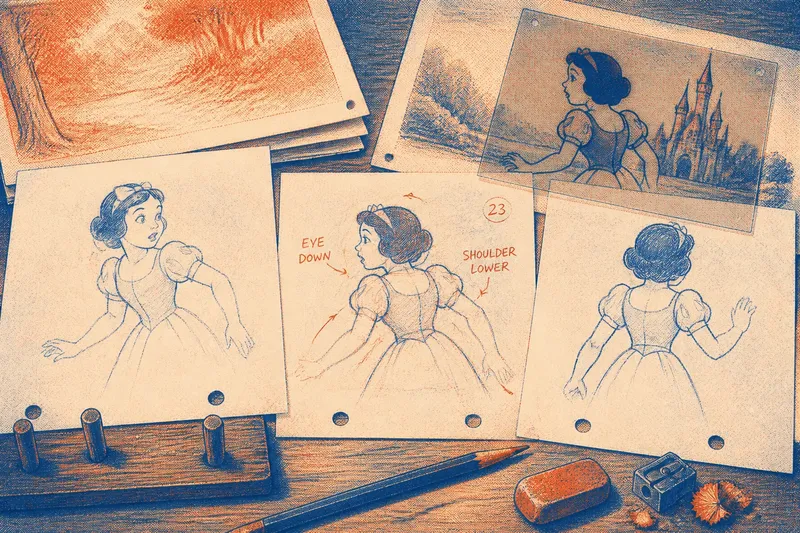
A pencil line darkens where an animator has changed a cheek or shifted a shoulder. Drawing animation on paper made such revisions part of the working image, not marks to hide; its history is also the history of how studios organised drawings into scenes and sequences.
There was no single moment when paper gave way to another method. Artists used paper for different tasks, and the adoption of transparent cels altered how a scene could be assembled without making paper drawings unnecessary.
Paper as a working surface
Before cel layers became a familiar production tool, artists could draw a complete image on each sheet, including the character and the setting. Émile Cohl’s Fantasmagorie (1908), for instance, is associated with drawn figures and changing forms photographed as a sequence. Such films demonstrate one approach, not a universal recipe for every early animation.
When every image is drawn as a whole, a background or prop may change slightly from sheet to sheet. That can produce visible fluctuation, but it also leaves room for the entire composition to transform. Paper offered a direct place to sketch and revise; the finished images still had to be photographed in order to appear as motion.
Drawings in production
In studio production, drawings could have distinct roles: rough poses established an action, while later drawings refined or connected those poses. The exact division of labour differed between studios and productions, so a surviving sheet should not be assigned a job solely because it looks rough or polished.
Disney’s Snow White and the Seven Dwarfs (1937) is a notable feature-length example of animation made through a studio process that used drawn animation and cel layers. Naming a production gives a concrete point of reference; it does not mean that every artist or studio followed an identical workflow.
Imagine an archive contains three hypothetical sheets of a character turning: a rough starting pose, a marked intermediate drawing and a cleaner pose facing away. If notes or matching scene details link them, an archivist could reasonably describe them as related stages of an action; without that evidence, the similar subject alone would not establish their original order.
Cels and stable backgrounds
Transparent celluloid sheets, commonly called cels, made it possible to separate some moving drawings from a background. A painted setting could remain in place while a character image on a cel changed between photographed frames. This was an important production option, rather than a wholesale replacement of paper.
Paper remained useful for planning, rough animation and revisions. A paper drawing may preserve construction marks or corrections; a cel can indicate that an image was prepared as a transparent layer for photographic assembly. Neither material, by itself, tells the full story of how a scene was made.
Reading surviving sheets
Production drawings survive in different conditions and with different records. A number, peg hole, annotation, matching background or archival description may help identify a sheet’s place in a sequence. The absence of such clues does not make the drawing meaningless, but it limits what can responsibly be claimed about its exact purpose.
For a collection display, several documented drawings from one scene can make production decisions more apparent than a single attractive sheet. The useful historical question is not simply how one pose changes into another, but what evidence connects those images: shared markings, production records, consistent scene details or established catalogue information.
- Observation: a sheet has a scene number matching an archival record. If the record identifies its production context, then use that context; otherwise, describe the number without assigning a scene.
- Observation: a drawing has peg holes that align with other sheets. If their marks and documentation also correspond, then consider them a related group; otherwise, treat the holes as evidence of handling or registration only.
- Observation: a cel is transparent and carries a character image. If a matching background or production note is present, then explain the layered assembly; otherwise, avoid claiming which background it was photographed over.
- Observation: a paper sheet contains rough construction lines. If sequence records connect it to other drawings, then describe its place in that sequence; otherwise, call it a rough drawing without inferring its production role.
- Observation: two images share a character and setting but have no matching marks or records. If independent documentation links them, then present them as related; otherwise, do not assume they belong to the same scene.
- Observation: a drawing is unusually clean or visually appealing. If provenance supports a production use, then state that use with its source; otherwise, describe its appearance rather than treating polish as proof of importance.
What can the evidence tell you?
Why draw on paper?
Paper provided a surface for making, revising and preserving drawn images. In production archives, its marks can sometimes reveal working choices, although the sheet’s precise role depends on supporting evidence.
Did cels replace paper?
No. Cels offered a way to photograph changing elements over a separate background, while paper remained useful for drawings and planning. The methods could form parts of the same production process.
What does a rough sheet prove?
By itself, it proves that a drawing with visible rough marks survives; it does not establish who made it, when, or how it was used. Notes, provenance and related production materials can support a more specific account.
How should a sequence be identified?
Look for documented links such as matching scene identifiers, annotations or archival records, rather than relying only on resemblance. If those links are missing, describe the visual relationship cautiously and leave the original order open.
Questions for an archive
To understand drawing animation on paper as history, begin with the evidence attached to the object: its material, marks, provenance and catalogue record. Then distinguish what is visible from what is inferred. That habit is more useful than trying to decode every stray pencil stroke.
It is not worth the effort to treat one isolated mark as a secret explanation of an entire production. A modest claim grounded in the sheet and its records is often more informative than a confident story the surviving evidence cannot support.
A paper drawing can preserve a working decision, but its historical meaning depends on context. Keep the object’s material evidence separate from what related documents establish, and you can appreciate both the artistry on the sheet and the limits of what it tells you.